Kidney Stone Removal Without Ope...
- Oct 19, 2026


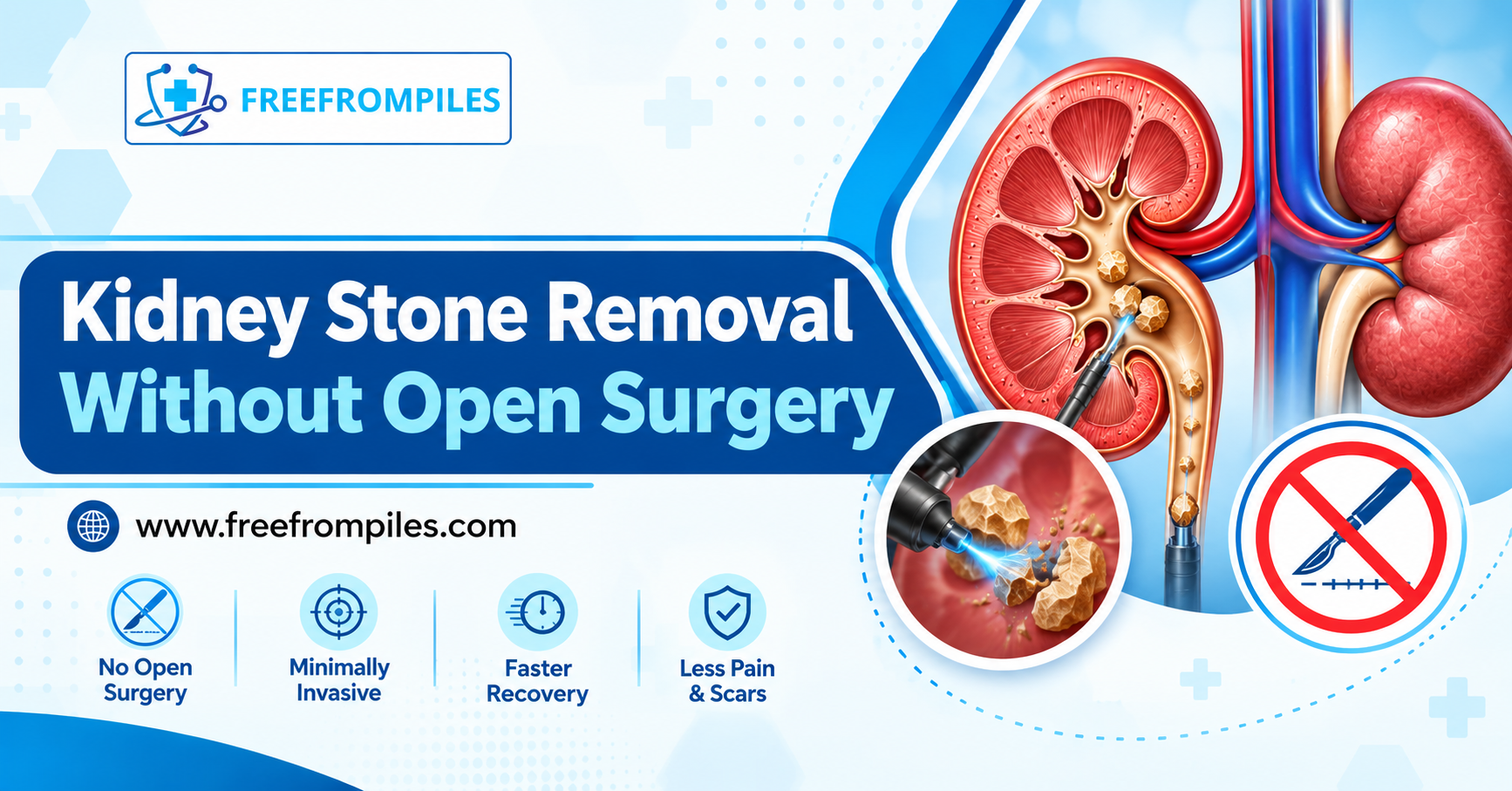
Ask anyone who has experienced a kidney stone, and they’ll tell you the pain can be unforgettable. It often starts suddenly, causing a sharp, twisting ache in the back or side, and immediately raises the question: “Will I need open surgery?” Fortunately, most kidney stones can be treated without making large surgical incisions. Modern medical techniques offer several minimally invasive options, and the best choice depends on the stone’s size, location, and symptom severity. Understanding these treatment methods can help patients feel more informed and confident about the available options for kidney stone removal.
Let’s walk through it the way a doctor would explain it across the table.
Yes, in most cases they can. Depending on the size, location, and hardness of the stone, doctors can use medicines, shockwaves, or thin telescopes to treat it. Open surgery is now rarely needed and is usually kept for very large or complicated stones.
Not always. Small stones, usually under 5 mm, often pass on their own with plenty of water, pain relief, and regular monitoring. Your doctor may also give medicines that relax the urinary tract so the stone slips out more easily.
But please don’t just “bear it” at home if you notice any of these:
These are warning signs. Seeing a doctor early can save you from bigger problems later.
If the stone is small and you’re managing well, your doctor may simply ask you to drink more water, take pain relief, and return for a scan or ultrasound. Sometimes that’s all it takes.
Think of it as breaking the stone from outside. Focused shockwaves crush the stone into tiny pieces, which you then pass in your urine over the next few days.
Sometimes a hard stone needs more than one sitting, and that’s completely normal.
A very thin telescope goes in through the natural urinary passage, so there’s no cut on your skin at all. The surgeon sees the stone directly and breaks it with a laser. It’s very effective, especially for stones stuck in the ureter, the tube between the kidney and bladder.
This is like ureteroscopy, but with a flexible scope that goes all the way into the kidney. It’s a great option for small to medium kidney stones, especially those that shockwaves can’t target well.
For bigger stones, PCNL is the keyhole option. Instead of a long surgical cut, a tiny opening (about the size of a button) is made in the back, and the stone is broken and removed through it.
It is not open surgery. The wound is small, the pain is lower, and recovery is much faster than the old-style operation.
Honestly, there’s no “one best method” for everyone. The right choice depends on:
That’s why a proper check-up comes first, usually an ultrasound, X-ray, or CT scan. A good doctor never decides the treatment without understanding your stone first.
Every stone and every patient is different, which is why choosing the right doctor matters. If you’re searching for a Kidney Stone Specialist in Bharatpur, you can consult Dr. Madhav Mayank Sharma at Pradeep Hospital and Fracture Clinic and Heart Centre.
Dr. Sharma takes the time to understand your case, explains the options in simple language, and helps you choose the treatment that actually suits you. You walk out of the consultation with clarity instead of confusion.
When you’re in pain, the last thing you want is to run from one place to another for tests, consultation, and treatment. Pradeep Hospital and Fracture Clinic and Heart Centre provides multi-speciality care for patients in Bharatpur and nearby areas, so diagnosis, treatment, and follow-up can happen in one place.
Getting the stone out is only half the battle. Stones can return, but small habits make a big difference:
A kidney stone can feel scary, but the treatment doesn’t have to be. Thanks to modern techniques like ESWL, laser ureteroscopy, RIRS, and PCNL, most people are treated without open surgery, with smaller wounds, less pain, and a quicker recovery.
The most important step is the first one: don’t ignore the symptoms. Back pain, burning urination, or blood in the urine are your body’s way of asking for attention. The earlier you get checked, the simpler the treatment usually is. And if you need a trusted General Surgeon in Bharatpur, book a consultation with Dr. Madhav Mayank Sharma at Pradeep Hospital and Fracture Clinic and Heart Centre and take the next step with confidence.
Yes. ESWL, ureteroscopy, RIRS, and PCNL are well-established procedures used worldwide. Every procedure has some small risks, and your surgeon will explain them before starting.
After ESWL or ureteroscopy, many people get back to light daily activities within a few days. PCNL may take a bit longer. Your doctor will guide you based on your case.
The procedure is done under anaesthesia, so you won’t feel pain during it. Mild burning while passing urine for a few days afterwards is common.
Yes, they can. That’s why drinking enough water, eating mindfully, and going for follow-ups matter so much.
If the stone is large, very painful, blocking urine flow, causing infection, or just not passing, it usually needs treatment. A scan and a specialist’s opinion will confirm it.
Small ones often do. Bigger stones usually don’t, and waiting too long can lead to infection or even kidney damage.
 Optimized by Seraphinite Accelerator


