Laparoscopic Surgery और Open Sur...
- Aug 31, 2026


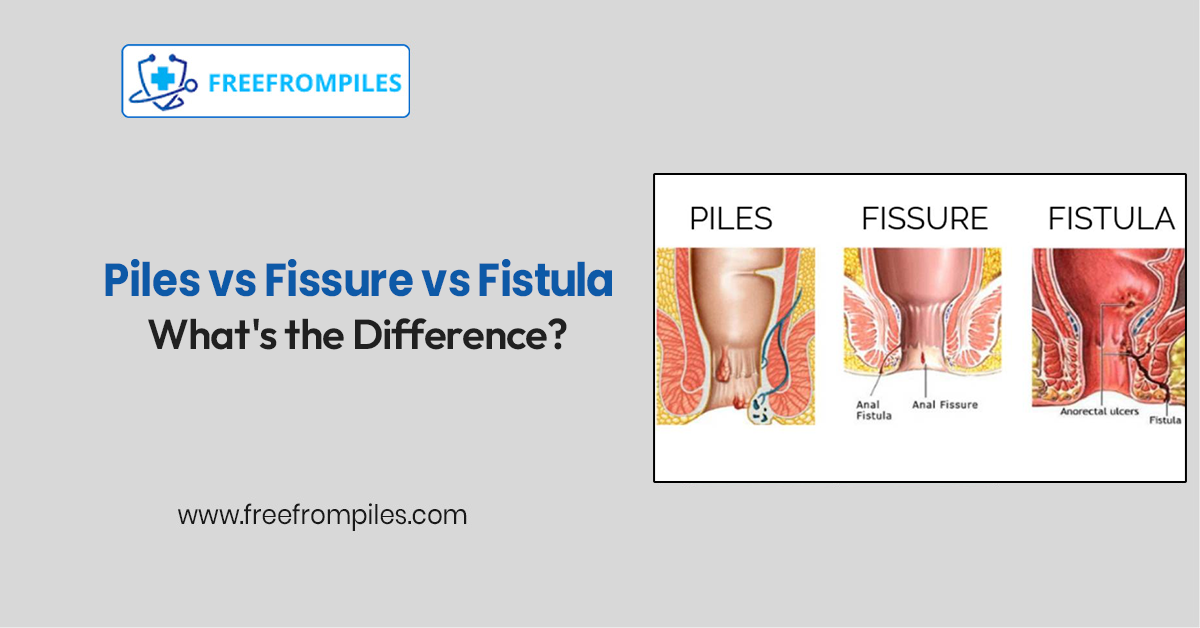
Most patients who come in with pain, bleeding, or discomfort around the anal area ask the same question first: “Doctor, is this piles, fissure, or fistula?” All three conditions affect the same general area of the body, so their symptoms can feel confusingly similar at first. But the underlying cause, the type of discomfort, and the treatment for each are quite different.
In this blog, we’ll break down exactly what separates Piles, Fissure, and Fistula, how to recognize each one, and when it’s time to see a doctor — so you can get the right treatment at the right time instead of guessing.
Piles, medically known as hemorrhoids, are swollen blood vessels located inside or around the anal canal. When these veins come under excess pressure, they become inflamed, leading to pain, itching, and bleeding.
Common symptoms of piles:
Common causes of piles:
In the early stages, piles often respond well to diet and lifestyle changes. But if bleeding continues or a prolapse develops, medical treatment becomes necessary. This is exactly where timely consultation with an experienced Piles Specialist in Bharatpur can help you avoid complications and prevent the condition from progressing to surgery.
An anal fissure is a small tear or cut in the lining of the anal canal. It usually happens while passing hard stool, and it causes a sharp, burning pain that can last long after the bowel movement is over.
Common symptoms of fissure:
Common causes of fissure:
The pain from a fissure is usually much sharper and longer-lasting than that of piles — this is the biggest point of confusion for most patients. If left untreated, a fissure can become chronic and won’t heal on its own. That’s why timely Fissure Treatment in Bharatpur is important to prevent the condition from becoming long-term.
An anal fistula is an abnormal tunnel-like channel that forms between the inside of the anal canal and the skin outside. It typically develops after an anal abscess (a collection of pus) that hasn’t drained or healed properly.
Common symptoms of fistula:
Common causes of fistula:
The most important thing to understand about a fistula is that it will not heal on its own. Medication may reduce symptoms temporarily, but the tunnel itself won’t close without intervention. This is why surgical Fistula Treatment in Bharatpur is considered the only permanent and effective solution.
| Point | Piles | Fissure | Fistula |
|---|---|---|---|
| What it is | Swollen blood vessels | A tear in the anal lining | An abnormal tunnel to the skin |
| Main symptom | Painless bleeding, lump | Sharp, burning pain after motion | Pus/fluid discharge |
| Type of pain | Mild to moderate | Sharp, burning, long-lasting | Dull ache with irritation |
| Bleeding | Bright red, common | Light streaks | Minimal, mixed with discharge |
| Can it heal on its own? | Possible in early stages | Sometimes, but may turn chronic | No, surgery is required |
| Common cause | Constipation, straining, pregnancy | Hard stool, injury | Unhealed abscess, Crohn’s disease |
Yes, it’s possible. Many patients have piles and a fissure together, since both often share the same underlying cause — chronic constipation and straining. This is exactly why self-diagnosis and home remedies can be risky. Only a proper physical examination and proctoscopy can confirm the exact condition and rule out overlapping issues.
Book a consultation right away if you notice any of the following:
None of these symptoms should be ignored. A fissure left untreated can turn chronic, and an untreated fistula carries the risk of spreading infection.
Advances in proctology mean Piles, Fissure, and Fistula can now all be treated with minimally invasive procedures that involve less pain and faster recovery:
At Pradeep Hospital, Bharatpur, Dr. Madhav Mayank Sharma performs same-day, laser-based, minimally invasive procedures for all three conditions, helping patients avoid long hospital stays and return to normal life quickly.
Q1. What is the main difference between piles and fistula?
Piles are swollen blood vessels that mainly cause bleeding, while a fistula is an abnormal tunnel that causes pus discharge. Their causes and treatments are completely different.
Q2. Can a fissure heal without surgery?
If the fissure is recent (acute), it often heals with diet changes, ointments, and sitz baths. However, if it becomes chronic, a minor procedure may be needed.
Q3. Can fistula be treated with medicine alone?
No. A fistula is a physical tunnel structure that medication cannot close. Surgical treatment is the only permanent solution.
Q4. How are piles, fissure, and fistula diagnosed?
A qualified surgeon confirms the exact diagnosis through a physical examination, proctoscopy, and, for fistulas, sometimes an MRI fistulogram.
Q5. Where can I get the best treatment for these conditions in Bharatpur?
Pradeep Hospital, Bharatpur offers advanced, laser-based treatment for all three conditions under Dr. Madhav Mayank Sharma, an experienced Laparoscopic & General Surgeon.
Dr. Madhav Mayank Sharma is a well-known Laparoscopic & General Surgeon based in Bharatpur, Rajasthan, practicing at Pradeep Hospital. With over 12 years of experience, he has helped thousands of patients find relief from Piles, Fissure, Fistula, and Pilonidal Sinus through laser-based, minimally invasive treatments. His approach focuses on patient comfort, minimal pain, and faster recovery.
If you or someone close to you is dealing with any of these symptoms, avoid self-medication and consult a specialist for a proper diagnosis instead.
 Optimized by Seraphinite Accelerator


